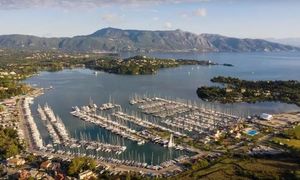
Focus on strategic marina in Ionian and Adriatic Seas
 Tensions and clashes in Parliament on Thursday between opposition MPs and the police/guards. SOURCE: ATA/Albanian News Agency.
CORFU. What links the unrest in the Albanian Parliament to Corfu?
Tensions in the Albanian Parliament — with smoke bombs, seat occupations, and a violently suspended session — are more than just another episode of political instability in Tirana. Behind the chaos lies a fierce struggle of interests that directly affects Corfu.
According to Reuters, the incidents were triggered by the appointment of the ombudsman and, in the background, the Special Anti-Corruption Prosecution’s (SPAK) request to lift the parliamentary immunity of Deputy Prime Minister and Minister of Infrastructure and Energy Belinda Balluku. Balluku oversees Albania’s ports, strategic infrastructure, and major investments, including the port of Durrës.
While the parliamentary unrest may not have been directly about her, Balluku — considered Prime Minister Edi Rama’s right hand — faces accusations of bypassing legal and institutional procedures to turn Durrës into an ultra-luxury real estate and marina project. She defends it as a “national development project,” while the opposition calls her the “minister of contractors.”
The real stakes go beyond a single project. The Durrës plan aims to create a central ultra-luxury marina hub for permanent berthing, home porting, full-service maintenance, and wintering of fleets — similar to Porto Montenegro in Tivat, the only comparable hub in the southern Adriatic.
This is where Corfu comes in. The Ionian Sea and southern Adriatic form a single maritime domain for large yachts. Whoever controls a home porting base controls vessel flow, services, and winter revenue. Corfu currently serves as a high-end destination but not as a central fleet hub.
At the same time, international investment funds are reshaping the maritime tourism corridor from Venice and Trieste to the Ionian and southern Mediterranean. Albania is no longer a “grey zone” and is entering the market aggressively. Governments along this route adapt their development strategies to meet the demands of this capital.
In this context, discussions about a large yacht marina in Mandouki are critical. A private investor partnered with the Greek state aims to position Corfu either as a competitor to Durrës or as a complementary hub.
Seen this way, the incidents in the Albanian Parliament are not “Balkan folklore.” They reflect the political dynamics of a fierce battle over control of a highly lucrative maritime geography — one that now inevitably includes Corfu.
GIORGOS KATSAITIS