Albania:‘Flamingo Revolution’ enters its 83rd day
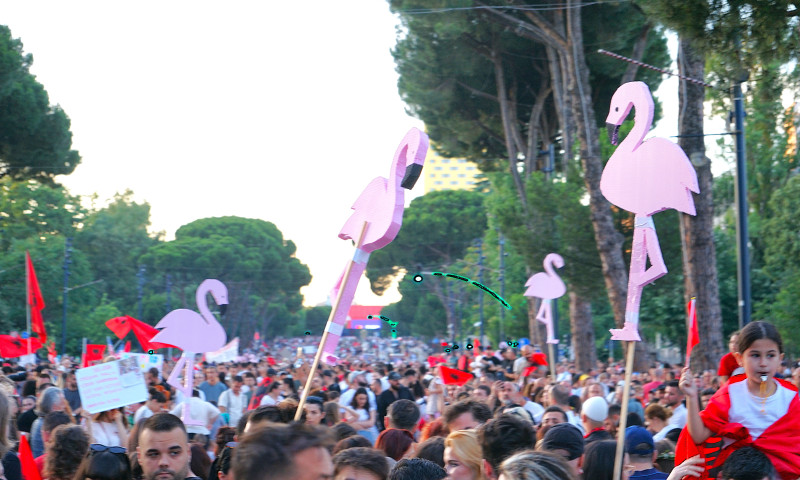 “Flamingo Revolution” protesters take to the streets of Tirana. Photo: Albinfo/Wikimedia Commons – CC BY 4.0
TIRANA. The environmental protest that emerged in opposition to major tourism investments has evolved into a months-long anti-government movement. On Friday, the 83rd consecutive protest was held, with no reliable estimate of the number of participants, while the demands are now directed openly against the Rama government.
For the 83rd day running, citizens taking part in the so-called “Movement” or “Flamingo Revolution” took to the streets on Friday, August 21, in a protest that began as a reaction to tourism development plans in the protected areas of Narta and Zvërnec and has now evolved into a broader anti-government movement.
According to Albanian media outlets Lapsi and Syri.net, protesters initially gathered in Skanderbeg Square before proceeding along “Dëshmorët e Kombit” Boulevard toward the Prime Minister’s Office. The dominant chants were “Rama, resign” and “Down with the government,” while speakers reiterated calls for Prime Minister Edi Rama to step down and for the political system to be changed.
Friday’s protest also had a strong social dimension. As reported by Lajmifundit, protesters’ placards referred to the rising cost of living, low wages, the departure of young people from the country and corruption. One carried the sarcastic message that prices are so high that “my salary is seeking political asylum,” along with a statement that Albanian youth have the right to live in their own country.
How many are protesting?
The picture over time is different. Reuters had already reported thousands of protesters taking to the streets of Tirana in early June, describing the June 10 demonstration as the largest gathering up to that point. In a report by Australia’s ABC, published on August 2, organisers estimated that around 3,000 people had attended the demonstration observed by the network’s crew.
The movement’s staying power is nevertheless remarkable. On August 18, European Western Balkans recorded the 80th consecutive protest and noted that participation had also been boosted by members of Albania’s large diaspora who had returned to the country to take part in the demonstrations.
From Narta to the Rama government
The uprising began in the Vlora–Narta–Zvërnec area. The first major reactions were sparked by plans for luxury tourism developments linked to Jared Kushner, the son-in-law of U.S. President Donald Trump.
According to Reuters, protesters argue that the development threatens a protected wetland that provides a habitat for flamingos, while the wider area is also home to seals and sea turtle nesting sites. The pink flamingo thus became the symbol of the protest movement.
The issue took on even greater significance when Reuters revealed in July that an Albanian businessman who had sold land rights for the planned complex was being investigated over possible falsification of property titles. Residents of Zvërnec have been challenging ownership of the land in court for more than a decade. There is no allegation of wrongdoing against Kushner or his company.
Over time, however, the demands have gone far beyond protecting the wetland. The movement is now calling for Rama’s resignation, a transitional technocratic government, changes to the electoral and political system, a review of legislative interventions concerning protected areas, and the removal of the so-called “old political establishment.” European Western Balkans describes the shift from an environmental protest to a broader challenge over corruption, governance and living standards.
The government refuses to back down
Edi Rama’s stance toward the movement remains essentially dismissive, although the government has made some moves to reconsider its environmental legislative framework.
In an interview with Reuters on June 8, the Albanian prime minister made clear that the investment would go ahead despite the protests. He argued that the project would contribute to the modernisation of Albania and that wildlife protection would be ensured. “I was elected to make these things happen,” was essentially his response to protesters’ demand that the project be abandoned.
In a later interview with Germany’s ZDF, Rama argued that the disputed property is privately owned, that there is not yet a final plan, and that state institutions are reviewing the project to ensure that the required standards are met. At the same time, he defended the need to attract major investments.
The government’s communication line toward the uprising has been even tougher. The independent Albanian outlet Reporter.al/BIRN reported that Rama has attributed aspects of the protest movement to external interference and disinformation, referring, among other things, to Iran and to an “algorithm proletariat.” He has also ruled out the possibility of resigning.
There was, however, one significant concession. In mid-July, Rama announced in Brussels that his government would reconsider controversial legislative changes concerning protected areas, a development that protesters described as a “moral victory.” This followed pressure from Brussels, with the European Commission calling on Albania to align without delay with EU environmental legislation as part of its accession process.
Three sailing boats from Italy
The 83rd day took on particular symbolic significance with the arrival in Vlora of three boats from the Global Sumud Flotilla from Italy. Al Jazeera confirmed the arrival of the three vessels on Friday and their connection with support for the “Flamingo Revolution.”
According to A2 News, the journey began in Brindisi and was organised as a symbolic reversal of the historic voyage of the ship Vlora: in August 1991, more than 20,000 Albanians crossed the Adriatic to Italy, while 35 years later members of the Albanian diaspora and Italian activists made the journey in the opposite direction. The delegation included activists, environmentalists, journalists and descendants of Albanian migrants from 1991.
The boats arrived in Vlora on Friday afternoon. According to the same sources, participants carried flags and flamingo symbols and were due to meet with communities in the Vjosa–Narta area, while their presence was also scheduled at Saturday’s, August 22, protest in Tirana.
Thus, almost three months after its launch, the “Flamingo Movement” is showing unusual staying power by Albanian standards. There is no evidence that the daily demonstrations are maintaining the numbers seen at the largest protests in June, but the 83rd consecutive day of street protests and the mobilisation of the diaspora indicate that the movement has not faded.
On the other hand, the government is showing no signs of political retreat on the movement’s central demand. Rama rejects calls for his resignation and continues to defend the strategy of major tourism investments. The confrontation has therefore moved beyond the question of “Will Zvërnec be built?” to a much broader one: What model of development—and what political system—does Albania want?
GIORGOS KATSAITIS