Askitario – In Nymphes, where history meets oral tradition
1789655437.jpg?crop=800,480) Photo: Alexandros Melidis
Photo: Alexandros Melidis
The story of Artemios Paisios, traditionally regarded as the founder of the legendary historic site at Nymphes.
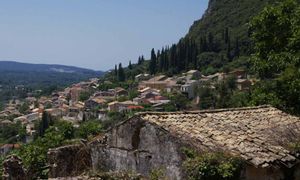
THE FAIRY VILLAGE OF OLD… Amid beautiful, forgotten legends, storybook memories and a landscape of incomparable natural beauty. With pine trees, olive trees, chestnuts and holm oaks. Oak trees, tall cypresses, holly oaks and trailing branches. Sounds. The wind and the birds, the nightingales. And the murmur of running waters cascading down from above, as if falling from the heavens, like the breath of invisible gods; the waterfalls of Nymphes.
There, they say, in times long past, fairies once dwelt. Nymphs — and their chief village, “Nymphes”. Ethereal beings of wondrous beauty, of divine descent, who there, on the banks of the spring, beside the crumbling remains of the stone watermills, would dance and sing with Pan, praising the gods.
In the deep of night. Before dawn arrived. In hidden places. Beyond the light…
THERE, our history was born. Interwoven with beliefs and legends, lost in the depths of centuries, buried deep underground. The monumental beginnings of Greek Christianity…
ONCE UPON A TIME, they say, sometime in the 5th or 6th century, a monk arrived in northern Corfu, wearing an Epirote cap. Searching for a place in which to live as a hermit, he found a secluded clearing on the northern side of the village. And there, near the abundant waters where the fairies of legend bathed, he discovered the wild “body” of a rock.
HIS SOUL was enchanted. And he settled there. He carved into the rock. He built himself a cell. And he stayed there, living the life of a hermit. At the “Askitario” (Hermitage)…
THE FATE of Artemios Paisios — that was his name — was never confirmed. Yet here too, legend had its say, passed down orally from one generation to the next: beyond his Askitario, they say, Artemios also carved a small chapel into the summit of the rock. From there, he would gaze out across the open sea.
ONE DAY as he looked out over those same waters, he thought he saw a ship. Unbeknownst to him, it carried his parents, who had come looking for him, hoping to persuade him to abandon his life as a hermit and return home.
HOW he came to know this, no one can say. But Artemios understood. And taking precautions, he dug a hollow in the ground, like a grave, and lay down inside it, praying. (According to another version, he entered a cave.)
SUDDENLY, a great rock broke loose from above. It fell, covering the grave — or, in the other version, the entrance to the cave.
“And with it, his destiny…” (Skalitis).
1789655431.jpg)
To the east, a path beside the streams leads to a rocky site. Recesses have been carved into the rocks. According to legend, Artemios made them. This was where he lived, and this was the rock that crushed him.
WHEN his parents arrived, they struggled to move the rock. They could not. The stone, legend has it, gave off sparks. And Artemios spoke to them from beneath it, telling them it was God’s will, and was buried there. (Chytiris also preserves an alternative version of the legend, according to which he was buried there to escape pirates.)
WHEN they realised that their child was dead, they were overcome with grief. And they decided to remain beside him. To become hermits themselves. There. Thus, they first built nearby the Church of the Pantokrator / Transfiguration of the Saviour — the focal point of the “Askitario” monastic complex. A basilica, renovated after the 17th century (possibly incorporating parts of the earlier church), and the remains of an ancient cypress trunk that had stood there, it seems, for centuries, like a sleepless guardian. And beside it, two adjoining original cells. For their own life of seclusion…
WHERE, precisely, the legend ends and historical truth begins is not easy to establish. The earliest written reference — “concerning the Askitario, that is, the Monastery of Christ the Saviour Pantokrator, known as Askytario” — appears in a notarial note dating from 1371, during the Angevin period. It refers to privileges held from long before and to considerable property (“vineyards, fields and olive trees, fruit-bearing and barren, timber and animals”), while describing it as “long renowned as miraculous and holy”. But just how “long before”…
WHAT IS certain is that by Byzantine times the Askitario had already developed extensive activity (scattered documents attest to financial transactions and correspondence with monasteries outside the island, including St Catherine’s Monastery of Sinai). And a sacredness that attracted a multitude of monks. From everywhere…
SOME came voluntarily. Others (and/or) out of necessity. Among them, in the 17th century, were four metropolitans who had been expelled because of their religious background: Porphyrios of Kastoria (1610), Kallinikos of Himara and Delvino (1680), Athanasios of Durrës (1727), and the Corfiot Athanasios Sopotos. All left behind, as relics, the ruins of their own stone cells. With their Christian symbols…
KEY SOURCES | Denis Kontarinis, “Askitario”, eftanhsa.blogspot.com • Theodoros Skalitis, “An Epirote Hermit at Nymphes”, corfiatikoanagnosma.blogspot.com • Anonymous, “Nymphes, the Fairy Village of Corfu”, faiakonnisos.blogspot.com.
THE AGRICULTURAL SCHOOL
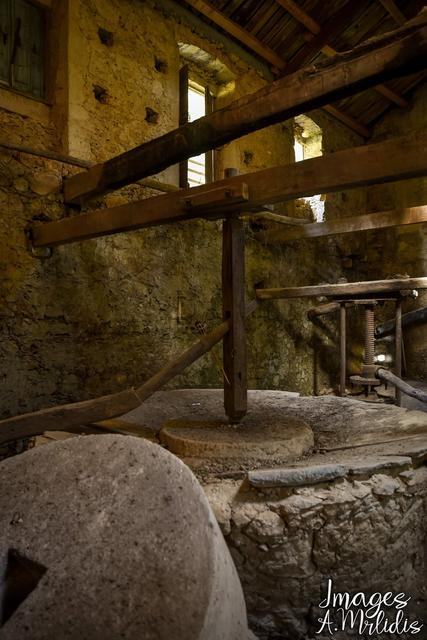
In 1931, north of the church, a Lower Agricultural School was established — essentially, this was the relocation of the Lower Agricultural School of Magoulades (founded in 1930), after the local community there failed to provide a plot of land. It was a stone-built, two-storey building with a basement, which housed an animal-powered olive press; the remains of the building are still standing there.
The two-year school operated for five years (until 1936), when it was abolished by Royal Decree because of limited interest. In total, 59 pupils enrolled during its five years of operation, of whom only 19 received their leaving certificate.
With the curriculum varying from year to year, the subjects taught were religion, Greek, mathematics, agriculture, local studies, arboriculture, beekeeping, sericulture, viticulture, agricultural industry, poultry farming, rural economics, horticulture, entomology, botany, dairy farming and practical training.
The school’s directors were T. Zervos, A. Provatas and M. Sotiriou (see O. Pachi, “The Lower Agricultural School of Nymphes, Corfu”, in the journal Kymothoi, issue 29, via academia.edu).
© PΗΟΤΟ CREDITS: AΛΕΞΑΝΔΡΟΣ ΜΕΛΙΔΗΣ
ELIAS ALEXOPOULOS