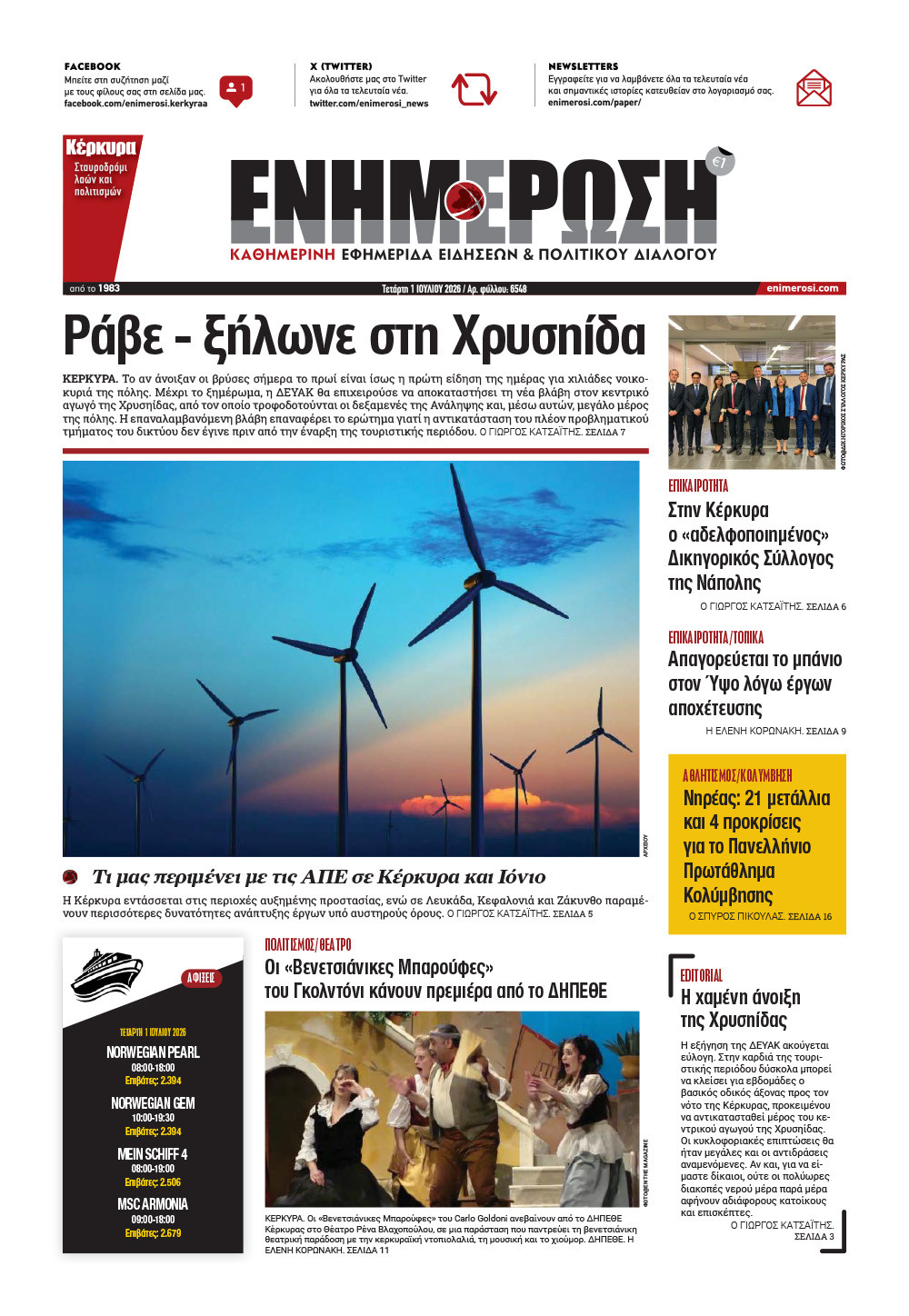
Special Regional Council meeting on new renewable energy zoning plan, with attention centered on Corfu and Ionian Islands.
 The Ionian Islands Regional Council is meeting in an extraordinary session in order to issue its opinion on the new Special Spatial Planning Framework for Renewable Energy Sources (RES), which will define the siting rules for wind and photovoltaic installations in the Ionian Islands. Archive photo
CORFU. The new spatial planning framework for wind and photovoltaic installations is being introduced under an urgent procedure as the sole item on the agenda of the Ionian Islands Regional Council, which is being called upon to give its opinion on the draft plan that will determine where and under what conditions renewable energy projects can be developed on the islands.
An emergency session of the Ionian Islands Regional Council is being convened on Monday, June 29 at 15:00, with the sole agenda item being the expression of an opinion on the Strategic Environmental Impact Assessment (SEA) of the new Special Spatial Planning Framework for Renewable Energy Sources (RES).
The meeting will take place via videoconference through the e:Presence.gov.gr platform, as, according to the invitation issued by the President of the Regional Council, Olympia Kardakari, an immediate decision is required following a relevant document from the General Secretariat for Natural Environment and Water of the Ministry of Environment and Energy.
The presentation will be delivered by the Deputy Regional Governor for Spatial Planning, Environment, and Climate Change, Spyridon Ioannou, who will outline the Region’s position on the study accompanying the new spatial planning framework.
The opinion is of particular importance for Corfu and the Ionian Islands as a whole, since the new framework does not provide a special regime for the region, but instead includes the islands under the general siting rules for RES projects, with additional restrictions arising from their strong natural, cultural, and touristic character.
According to the SEA, exclusion zones for large-scale renewable energy projects are being tightened in areas such as Natura 2000 sites, wetlands, archaeological sites, landscapes of outstanding natural beauty, traditional settlements, and other areas of high environmental or cultural value. These provisions directly affect a large part of Corfu, Paxos, and the Diapontia Islands, where protected areas cover a significant portion of land.
At the same time, the new spatial framework does not exclude the development of RES projects on the islands. On the contrary, it aims to direct installations to areas considered more suitable, based on distance from settlements, the carrying capacity of each area, landscape protection, and compatibility with other land uses. For the first time, energy storage installations are also included in the planning.
Of particular interest is the fact that Corfu is not classified as a blanket exclusion zone for renewable energy projects. Each investment will be assessed individually, based on environmental and spatial criteria. However, several local government and scientific bodies have already expressed reservations, arguing that the general criteria of the plan do not adequately reflect the specific characteristics of a densely populated and highly touristic island environment such as Corfu.
The session is expected to constitute the first official position of the Ionian Islands Region on a spatial planning framework that will define the development conditions for renewable energy sources over the coming years and is expected to affect both investment prospects and the protection of the unique natural landscape of the Ionian Islands.
GIORGOS KATSAITIS