Costly waste management, structural deadlocks, and what could change
 Enimerosi archive
CORFU. The dependence on transporting mixed waste off the island, the extremely costly logistics, the low recycling rates resulting from obvious and long-standing mismanagement, as well as the chronic understaffing of the cleaning service, have created a model that places suffocating pressure on both municipal charges and the municipality’s finances.
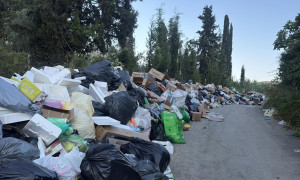
Corfu has, in recent years, become the most expensive large municipality in Greece in terms of waste management. The problem is not limited to the appearance of overflowing bins or waste collection itself, but concerns an entire operational model shaped by chronic poor governance — political and administrative alike — combined with insularity, intense tourism pressure, seasonal fluctuations in waste volumes, low recycling rates, costly private contracts, the eventual export of large quantities of mixed waste, and chronic understaffing in municipal administration.
According to official figures from the Municipality of Central Corfu and Diapontia Islands, sanitation expenses amounted to approximately €16.9 million in 2022, €20.8 million in 2023, and €22.7 million in 2024. The municipality itself argued that municipal charges were no longer sufficient to cover the costs, citing major deficits as the main justification for increasing municipal sanitation charges. Source
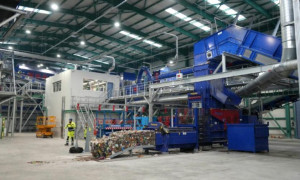
The real cost does not arise solely from transportation. The chain includes waste collection on the island, transfer and compression of waste, maritime transport to Igoumenitsa, overland transport within Epirus or elsewhere, processing at Waste Treatment Plants (MEA), final disposal of residual waste, and landfill taxes. The 2026 agreement with facilities in Epirus provides for up to 22,500 tons of waste at a charge of approximately €105 per ton solely for processing and final disposal. Source
At the same time, figures released in 2025 stated that transporting waste out of Corfu alone cost approximately €6.5 million annually. Source
Based on available data, the total real cost for each ton of mixed waste in Corfu is estimated at roughly €300–340 per ton. Collection by private contractors ranges from approximately €90–112 per ton, transfer and logistics from €15–25, maritime and land transportation remain exceptionally expensive, processing at the MEA costs around €105 per ton, and landfill taxes amount to approximately €35–45 per ton. The result is one of the most expensive — if not the single most expensive — waste management models in Greece.
A comparison with a large mainland municipality illustrates the scale of the disparity. In Patras, according to data from the Achaia Solid Waste Management Association and related reports, current costs range from approximately €40–70 per ton and are expected to reach around €95–100 per ton once the Floka Waste Treatment Plant becomes operational. Source and Source
The comparison shows that Corfu’s core problem is not merely waste collection itself, but the overall management and logistics model.
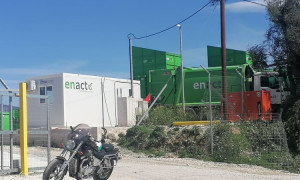
At the centre of public debate was also the waste collection contract awarded to the company ENACT. The main contract provided for the collection of 36,000 tons at a total cost of approximately €4.03 million, or about €112 per ton including VAT. Source
Based on estimates derived from comparable well-organised municipal systems, collection costs could theoretically range from approximately €55–80 per ton if carried out by a fully organised municipal sanitation service. Even then, however, the substantial cost of exporting waste off the island would remain.
A different maritime transport model could also change part of the picture. Today, waste is transported via the conventional ferry network, with trucks using standard ferry boats. A dedicated nighttime shipping line with stable Ro-Ro logistics, multi-year contracts, and possible state subsidies could theoretically reduce transportation costs, waiting times, and logistical failures significantly. Potential savings from combining organised municipal waste collection with specialised maritime transport are estimated at approximately €1.6–2.9 million annually.
Recycling is perhaps the most critical — yet also the most underestimated — factor in the economic equation. In Corfu, recycling is not merely environmental policy but a direct cost-reduction tool. Every ton that does not become mixed waste avoids ferry transport, overland transport, MEA processing costs, and landfill taxes. Today, the actual recycling rate in Central Corfu is estimated at approximately 8–12%, compared with around 12–18% in Patras. Source and Source
If Corfu increased recycling from 10% to 20% (notably, the Ydraiou administration had once promised rates as high as 50%), potential savings could reach approximately €1.4 million annually. At rates approaching 30%, the financial benefit could rise to approximately €2.5–3 million per year.
The political confrontation surrounding waste management has also been intense. The administration of Meropi Ydraiou was accused by the opposition of maintaining extremely low recycling rates and operating primarily through crisis-management logic. Figures cited by opposition groups suggested actual recycling rates of only around 4.5–6%. Source and Source
Stefanos Poulimenos was elected promising a more organised system, greater municipal management, and stronger recycling efforts. However, his administration continued relying on private contractors, maintained dependence on exporting large quantities of mixed waste — with all the associated consequences — and thereby inevitably led the system toward major increases in municipal charges. He is nevertheless credited with stabilising waste transport and securing agreements with Epirus and other regions for waste processing. Source and Source
Behind the private contracts, MEAs, and municipal sanitation charges, however, lies a deeper problem: the organisation of the sanitation service itself. Corfu has for years been administered in what many describe as an “amateurish” manner, with chronic understaffing, a lack of specialised leadership, shortages of drivers, an aging vehicle fleet, weak technocratic administration, and extremely short-term planning. The issue does not concern only collection workers, but also the absence of a hierarchy of specialised engineers, logistics managers, fleet managers, GIS operators, environmental specialists, and data analysts.
The sanitation department of a large island municipality can no longer operate like a traditional municipal department. It must function as a modern logistics hub and environmental infrastructure system. For approximately 70,000 tons of waste annually, an organised model would require roughly 205–290 core personnel and a total workforce of 280–380 people during peak tourist season, alongside a modern fleet, transfer stations, compression systems, fleet management infrastructure, and a 24-hour dispatch centre.
The conclusion is that Corfu’s problem is not merely technical. It is simultaneously environmental, administrative, logistical, organisational, and deeply economic. Public discussion often focuses narrowly on the MEA, yet the real reform concerns the overall operational model of sanitation services: staffing, recycling, separating at source, logistics, maritime transportation, and the capacity of an island municipality to operate as a modern environmental management service. Without such comprehensive change, even new infrastructure projects are unlikely to substantially reduce costs and municipal sanitation charges.
GIORGOS KATSAITIS